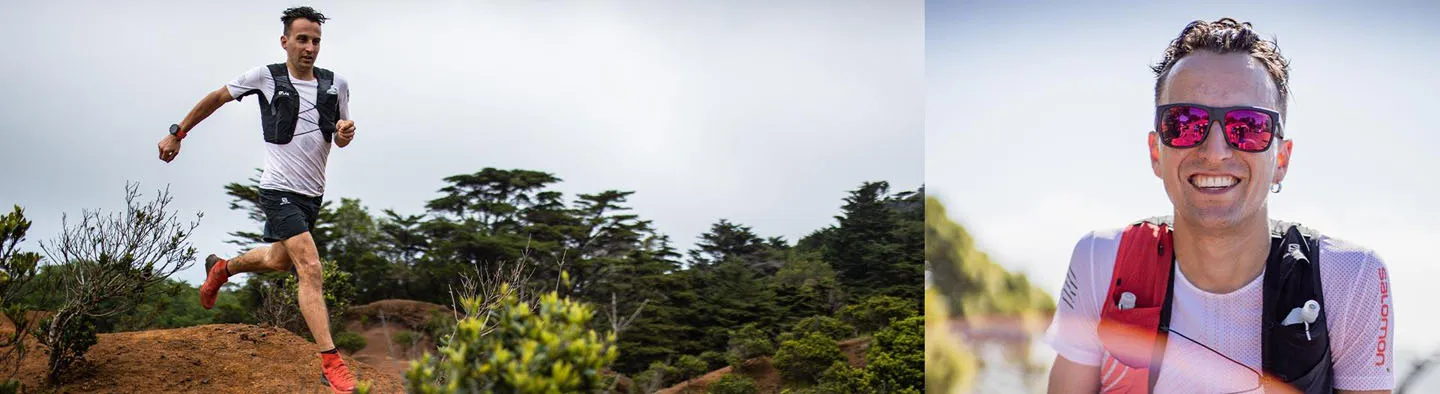
Sébastien Spehler's 45km Trail tips
Of course, appropriate training in the weeks and months leading up to the race is essential. This type of profile with "only" 900m of D+ over 45km is not to be taken lightly. It's a race that's bound to be run fast. Fast and long, with plenty of restarts and small bumps to break the rhythm. So there's not much to neglect in training, whether it's speed, threshold or fast climbs. It's a race format that's more complete than you might think.
But be careful not to overdo it in the last ten days before the race. At that point, the idea of improving performance is no longer on the agenda. You really need to run with a view to physical maintenance, cleansing and, as we like to say in running, "juicing".
Race day
My first piece of advice, always easy to say but very often difficult to apply: don't start too quickly. Unfortunately, the concept of "what's caught is caught" doesn't work in running. So try to find your running rhythm quickly, without worrying about the rest.
My second piece of advice would be to manage the climbs and bumps on the course. In the final analysis, given the difference in altitude/km ratio, this race is not a success on the climbs, but rather on the rolling sections. So, rather than starting out with the idea of being at ease on every climb, take advantage of the short descents to recover and relax, so you can run fully when you need to.
As far as diet is concerned, this is a very generalized question because everyone is very different in this respect, and if your daily diet is working properly, why change anything?
However, on formats where the pace is generally fast, I advise you to opt for energy drinks rather than solids such as bars. It's much easier to assimilate the benefits of the drink and, given the pace, there's much less risk of stomach upsets.
Finally, I'd like to talk about shoes, which are never easy to choose. Of course, "fast and light" shoes are tempting. The wisest thing to do is check the weather forecast in the days leading up to the race, as this terrain can quickly become very muddy. Personally, I'm not going to take any risks and will go for a versatile shoe like the Salomon Pulsar or Salomon Sense SG.
How do you approach the Trail 45km?
I love this format of the EcoTrail Paris, really no pressure and a lot of fun. It's a race to get back into the swing of things before a long season ahead. That's why I like the format of 45km and 900M D+. A mix of speed and endurance, I think it's an ideal race for me at this time of year. Physically, I'm feeling good at the moment, and I'm really looking forward to it too. So I'm looking forward to the Paris race on March 19.
Pitfalls to avoid
The first pitfall for me will be race management, starting off a little too quickly, carried away by the very playful terrain of the long-awaited race numbers... Don't burn your wings in the first few kilometers. It's still 45km, more than a marathon, but with a lot of hills, bumps, mud and restarts. So there's a lot of effort management to be done, even if you're in a hurry. :)
Then I'd say the condition of the terrain. For me, that's what makes this race so special. There are some really fast sections on very clean ground, and some slippery, brittle sections. That's why I'm going to start with shoes that I'd call all-purpose, like the Salomon Pulsar or the Salomon Sense SG.
Seb's tips
As for the tips, I think I've said it all. Quickly find your own pace without getting carried away. The choice of running shoes is of course essential. I don't think we'll be particularly hot on March 19. But even so, don't forget to hydrate throughout the run.
The rest is up to the race and we adapt to it.
Have a great race! :)

Since 1947, we at Salomon have been committed to creating innovations that shape the future of sport. Guided by our core values (Imagination, Family Spirit, Commitment, Simplicity, and Diversity), we strive to bring out the best in everyone through mountain sports.




