
Interview with Hervé Pardailhé-Galabrun, founder of EcoTrail Paris®.
Today, Hervé tells us about the birth of the event, its eco-responsible DNA and its evolution.
Could you introduce yourself in a few words?
I've been passionate about nature sports since I was a child. In 2001, I created a sports association to practice, promote and organize multi-sport nature raids (orienteering, mountain biking, canoeing, kayaking, etc.). I really witnessed the birth of trail running, because at the time there was no such thing as trail running. In France, there were already some very fine nature running events such as the Diagonale des Fous and the Templiers. I think it was the Ultra-Trail du Mont-Blanc® in particular, which was born in 2003 and triggered something special for the discipline, and I was lucky enough to take part in two editions of the UTMB®.
Today, I'm President of Eco-Trail Organisation® and one of the founders of the EcoTrail Paris Ile-de-France®.
How did you come up with the idea for the EcoTrail Paris Ile-de-France® and why a trail in Paris?
What happened was that in 2007, I was doing a lot of training in the Île-de-France region, in the various forest massifs. So I knew the region's forests and trails inside out. The idea came about when a group of enthusiasts got together to create a Trail à Paris. From the outset, the idea was to use Trail-Running to discover the trails of the Ile-de-France region, and its forest and cultural heritage.
We first tested the Trail 80km route. When we set off from the Saint-Quentin-en-Yvelines leisure island and arrived at the Eiffel Tower in the evening, which was glittering, I personally got chills! It was exceptional to see that it was possible to draw up a real Trail through the forests of the Ile-de-France region, with a finish right in the heart of Paris. As a result, the EcoTrail Paris Ile-de-France® was created, and its first edition took place in February 2008.
The EcoTrail Paris Ile-de-France® is an event based on the following founding pillars: universality, fairness, authenticity, solidarity, respect for the principles of sustainable development, and promotion of the regions.
One of the pillars of the EcoTrail Paris Ile-de-France® is eco-responsibility. How and why did you integrate it into the DNA of this project?
At the time, I was a regular participant in Trail events and I saw all the garbage that was thrown away during these races and it was something that really irritated me. I couldn't understand how some runners could just throw everything on the ground (gel tubes, cereal bar wrappers, plastic bottles, sometimes clothes...). What's more, I was often in the first quarter of the pack. I can't even imagine what it was like afterwards...
So from the very first edition, from a carbon footprint point of view, we told ourselves that we wanted to leave as few "traces" as possible of the runners' passage after the EcoTrail Paris Ile-de-France®. If we organize a race, it's not to dirty nature. That's why, from the very first edition, we came up with the idea of setting up eco-responsible actions, such as the distribution of a compulsory waste bag, attached to the bag. Runners had to put their garbage, gels, packaging, etc. in it... Runners had to commit to respecting nature by signing an ethical charter when they received their race numbers. To encourage runners to use alternative means of transport, we already provided them with a ticket for the Ile-de-France transport network to get to the start areas. We had also set up waste sorting garbage cans at the refreshment points. However, there was little respect for this during the first edition, as waste was mixed together and it was left to the volunteers to sort it out afterwards... Since then, we've had eco-actors coordinating the sorting of waste.
It was really a global approach that became part of the DNA of the event from the outset;
How has the event evolved over the years? How do you see it evolving?
It's interesting because you can see how sustainable development has evolved over the years. At the very beginning, there was a lot of resistance. We had to do a lot of educating.
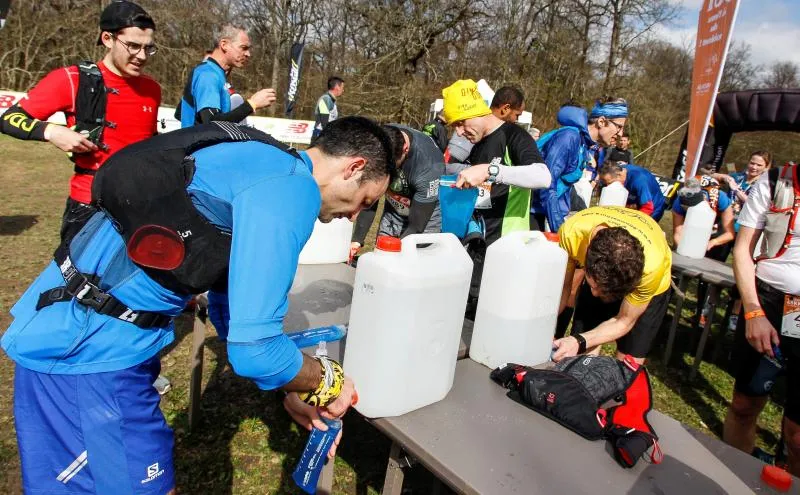
Let me give you a specific example that goes back several years. We were lynched when we decided to do away with plastic and therefore water bottles and cups at the refreshment stands. It took a long time, but little by little we succeeded. In fact, we had added personal cups to the compulsory equipment, but some people arrived at the refreshment posts with nothing. They asked the volunteers for cups, but the volunteers couldn't give them any because there weren't any. As a result, some runners became irritated with this eco-responsible action. It took about two years for this approach to be accepted. And it really was a revolution that took place little by little!
With hindsight, I can say that waste sorting is starting to become part of the public's habits in the Trail world, but it took a long time too. Today, we can see that runners are much more attentive to respect for nature and eco-responsible gestures.
We also took part in the creation of an "eco-responsible event" charter with the city of Paris, which we were already applying within our organization and which has enabled other organizers to integrate this notion of sustainable development. Since then, we have also signed the Charter of 15 eco-responsible commitments for major sporting events, drawn up by the French Ministry of Sport and WWF France. This charter enables us to set objectives each year to improve our eco-responsible actions.
This clearly shows that this approach is essential today.
As an organizer, we must always challenge ourselves, particularly through the carbon footprint that we carry out regularly and which we try to improve over the years.
What message would you like to pass on to the runners of this 14th edition?
We continued our eco-responsible approach for this 14th edition of the EcoTrail Paris Ile-de-France®. We again set ourselves objectives that may seem difficult for some of our participants, such as doing away with the finisher's T-shirt. It was a real weight on our carbon footprint. This action is an essential choice at this stage of our development, and we hope that runners will understand this strong message. We hope to be quickly followed by other organizers for the good of our planet.
We have the will and ambition to go even further in this approach. We want to become a real awareness-raising platform, to mobilize as many runners as possible around environmental issues.
Banning all use of fossil fuels, and thus decarbonizing the event as much as possible, is also one of the major areas we're working on.

Continue the adventure
Other subjects that might inspire you
Stay tuned!
Articles about this partner are coming soon!
Articles about this partner are coming soon!